Breakthrough AI Creates Real-Time "Digital Twins" for Healthier Buildings
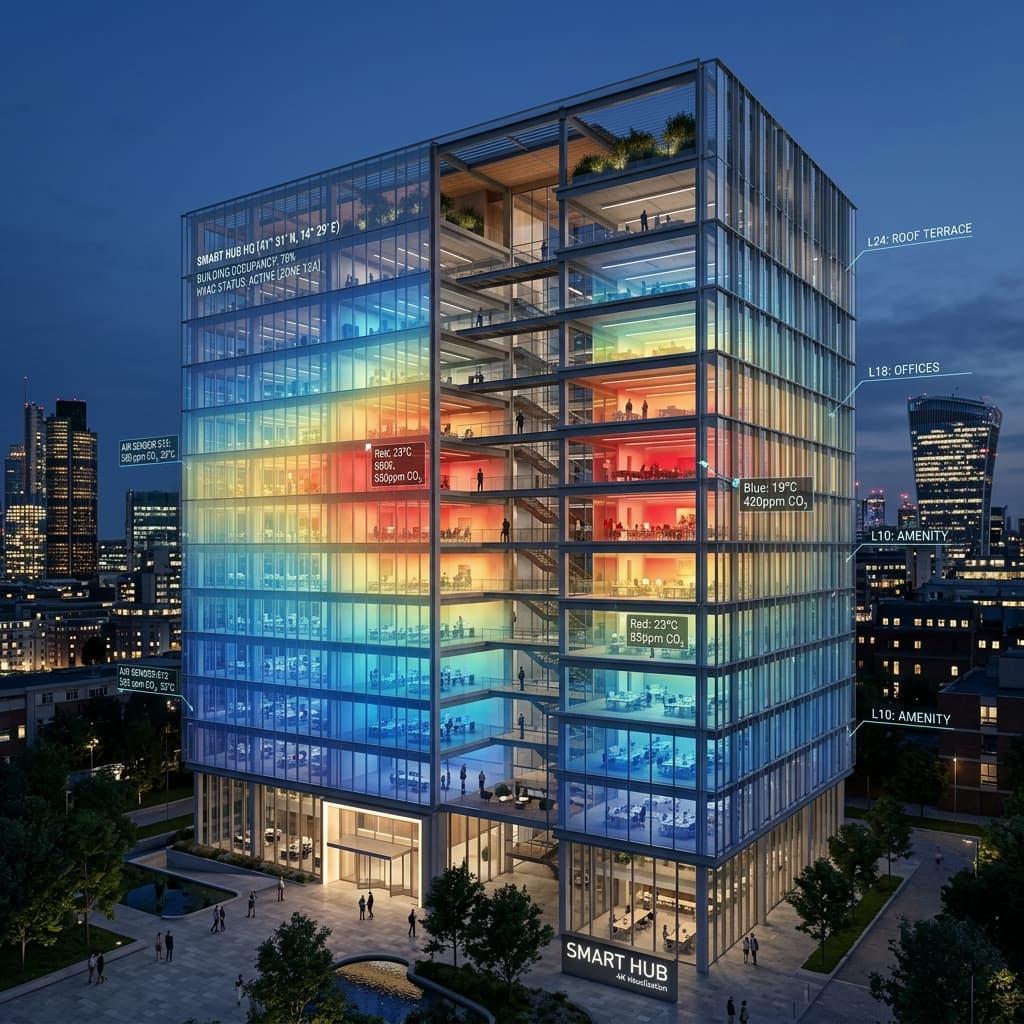
Keeping indoor air clean and safe is crucial for public health and energy-efficient building management. Traditionally, tracking air quality has been a major challenge: physical sensors only capture data in isolated spots, while highly accurate computer simulations take far too long to be practically useful in the moment.
A newly developed AI framework is solving this problem by generating real-time "digital twins" of physical rooms.
Research Topic
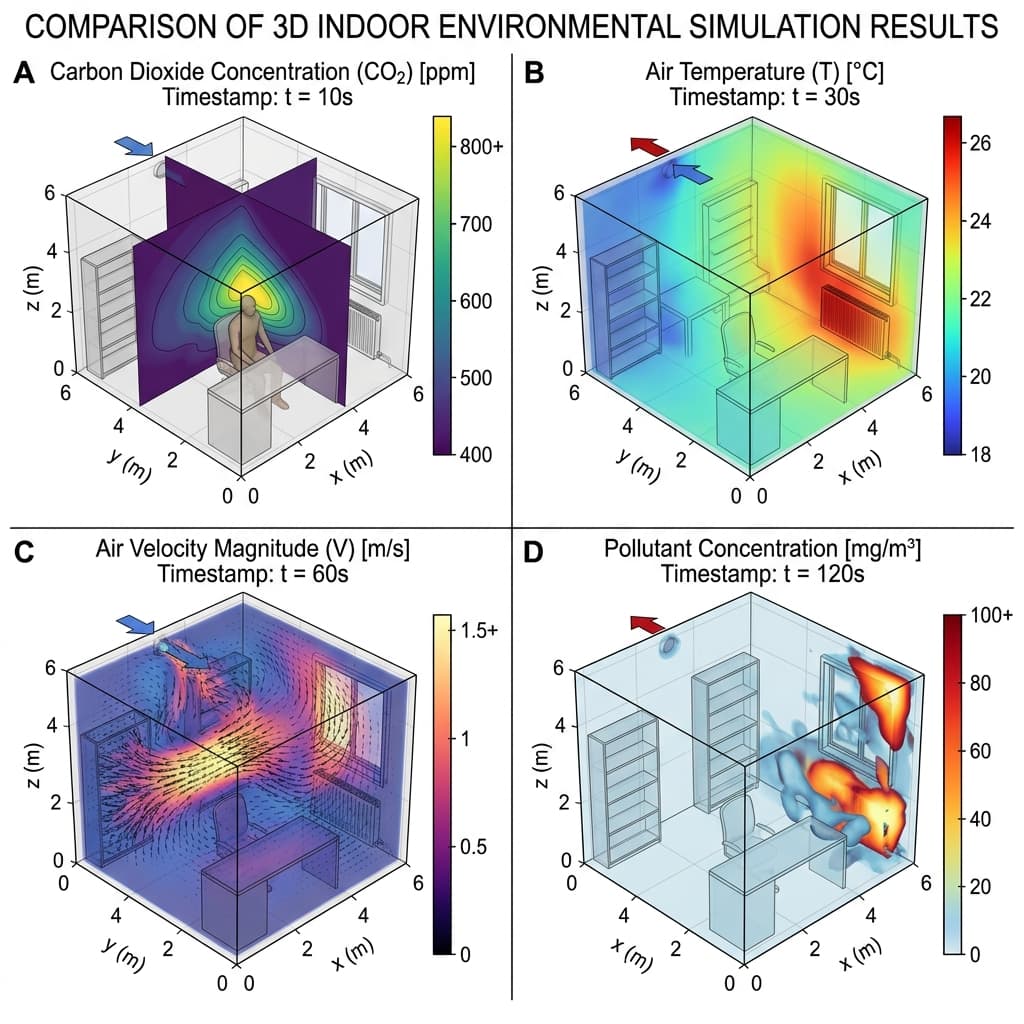
This research focuses on real-time indoor environmental monitoring and smart building optimization. Specifically, it explores how artificial intelligence can be used to accurately map and predict four-dimensional (x, y, z, t) physical fields, such as CO2 concentration, temperature, airflow, and pollutant levels, across an entire room using only a limited number of standard sensors.
What are the Potentials and Breakthroughs?
The core breakthrough lies in overcoming the limitations of standard deep neural networks and traditional fluid dynamics simulations.
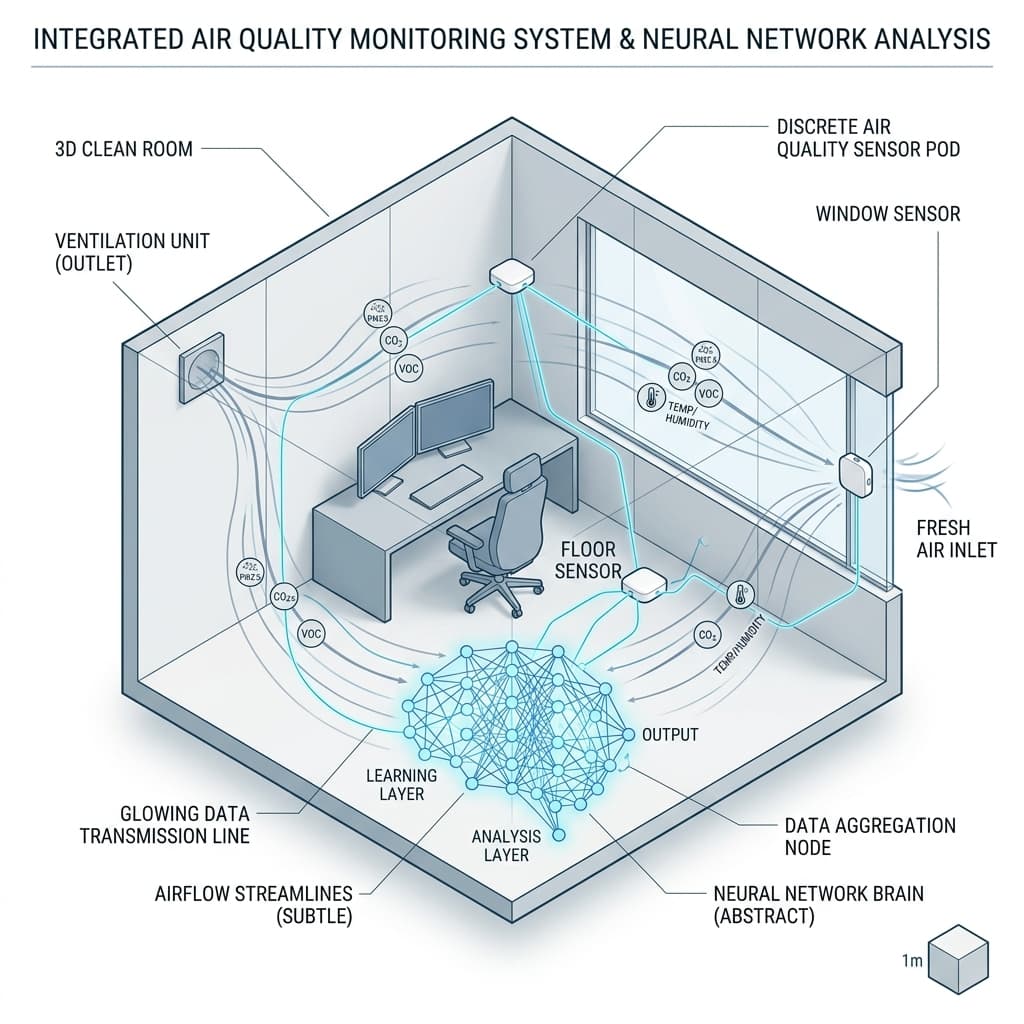
The Technological Leap: Standard neural networks often flatten input arrays, which destroys the complex, unstructured topological relationships of 3D spatial data. This new architecture solves that by successfully learning the complex mapping from discrete, isolated sensor observations to continuous, multidimensional physical fields.
Key Potentials
- ✦Bridging the Gap: It effectively bridges the gap between sparse physical sensor data and slow computational simulations, generating full 4D environmental maps instantly.
- ✦Turning Basic Tech into Advanced Maps: It has the potential to transform a few basic, low-cost sensors into a comprehensive, dynamic 3D map of a room’s environment, revolutionizing how we understand indoor airflow and contamination spread.
What are the Benefits?
The real-world impacts for smart buildings, facility management, and public health are massive:
- ✦Instant Awareness: The AI maps out the temperature, airflow, and pollutant levels of an entire room in just a fraction of a second, allowing for immediate response to environmental hazards.
- ✦Highly Accessible & Cost-Effective: Because the system is highly optimized, it does not require expensive supercomputers to run. It can operate seamlessly on standard computer hardware, making it highly practical for everyday, widespread deployment.
- ✦Healthier, Greener Spaces: By knowing exactly how air and pollutants are moving in real-time, building systems can automatically and precisely adjust their ventilation. This ensures maximum respiratory safety for occupants while simultaneously cutting down on wasted energy from over-ventilating.